


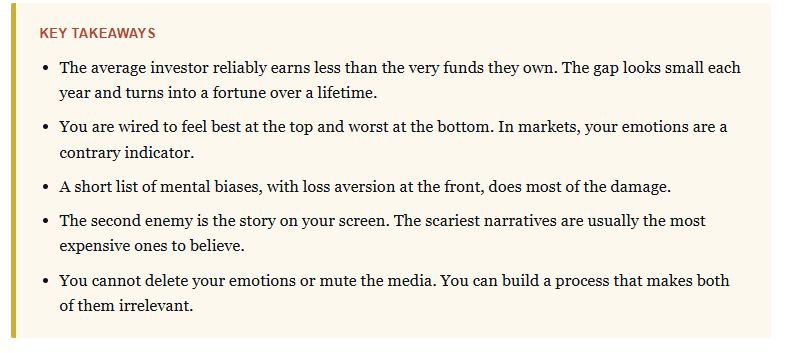
In the first part of this series, I promised that the next enemy we would face is the one you cannot fire, mute, or unfollow, because it is “You.” You can learn every valuation metric ever invented, memorize the two questions that decide everything, and still hand most of your returns back to the market for one simple reason.** You are human, and humans are built to do exactly the wrong thing at exactly the wrong moment** – it is investor psychology
Being human is not a character flaw; it is just our genetic wiring. The same instincts that kept our ancestors alive, like running from danger, following the herd, and vividly remembering the last scary thing, are catastrophic when applied to a brokerage account. Notably, there is a second enemy that is subtler than the first. It is the set of reflexes, our investor psychology, that the market itself has trained into you, year after year, until you mistake them for wisdom. One enemy is how you are built. The second is how you have been trained.
This article is about both. Let’s start with the one in the mirror.
You Are Your Own Worst Enemy
Here is one of the most uncomfortable facts in all of investing. The average investor does not just underperform some fancy benchmark. The average investor underperforms the very funds they themselves own. The fund increases by a certain amount, but the person holding it somehow captures less of the increase. Every year…like clockwork.
Morningstar measures this every year in a study called “Mind the Gap.” In the most recent edition (2025), covering the ten years through the end of 2024, the average dollar invested in U.S. funds earned about 7.0% a year, while the funds themselves returned 8.2%. That is a gap of roughly 1.2 percentage points per year, and Morningstar has found it to be stubbornly persistent across every ten-year window it measures. The money did not vanish into fees, but rather due to investor psychology. Buying after things had already run up, selling after they had already fallen, and doing it over and over.
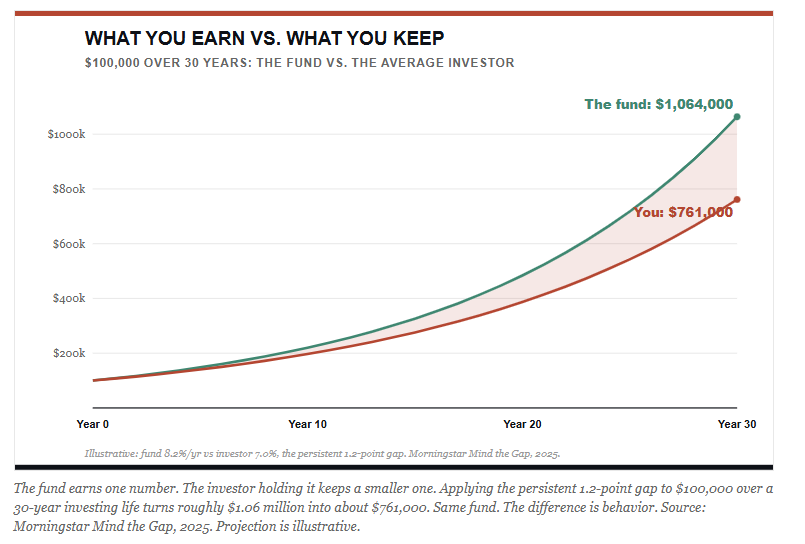
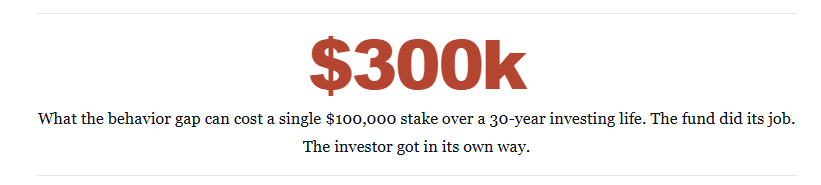
Examine closely what that “small” gap does over a lifetime. A 1.2% shortfall sounds like a rounding error, but stretch it over 30 years, and it quietly consumes about $300,000 from a $100,000 starting stake. Put that into some context, that is not just a rounding error; it is the cost of a house.
Let’s be fair, though, as researchers argue about how much of this gap is pure bad timing versus the simple mechanics of when people happen to have money to invest. That debate is real, and the whole 1.2% isn’t due to just self-sabotage. But the direction is not in question, and neither is the cause you can actually control. When you trade on emotion, you will lose, and the more you trade, the more you will lose. Morningstar found exactly that truth:
“The investors who touched their portfolios the least kept the most.”
The Cycle That Traps You Every Time
So, if that is the case, then why do smart, capable people buy high and sell low with such reliability? The reasoning is basic because it feels right at that particular moment. Every market cycle runs on the same emotional script, and that script is engineered to separate you from your money at both ends.

Read that chart slowly, because you have lived it. Near the top, after a long climb, you feel terrific. The gains look easy, everyone at the barbecue is a genius, and that feeling has a name on this chart. Euphoria. And it sits directly above the words “point of maximum financial risk.” At the bottom, after everything has fallen apart, you feel sick, and you swear you will never touch a stock again. That is despondency, and it sits directly above “point of maximum opportunity.” Your investor psychology is just unhelpful here…it is pointed exactly backward.
Bob Farrell, who watched Wall Street for half a century, wrote it into his rules decades ago.
“The public buys the most at the top and the least at the bottom.”
This is not because people are stupid, but because the top feels safe and the bottom feels terrifying. Howard Marks makes the same point about investor psychology from the other direction.
“The most dangerous thing in markets is the widespread belief that there is no danger. When nobody is afraid, everyone has already bought, and there is no one left to push prices higher.“
The Four Biases That Do The Damage
Investor psychology is powered by a handful of specific mental shortcuts. Psychologists have cataloged dozens, but four do most of the financial damage. You do not need a degree to recognize them, since you have likely already experienced every single one.

Naming a trap is the first step to seeing it coming, so let’s take each one in turn. These are not abstractions. Each has a specific moment where it reaches into your account and takes something.
Loss aversion is the heavyweight in investor psychology, so we will start there. Daniel Kahneman won a Nobel Prize partly for showing that the pain of losing a dollar runs about twice as deep as the pleasure of making one. Two to one. That single asymmetry explains most of the bad sell decisions you have ever made, and it is why a position that is down 40% becomes impossible to sell, because booking the loss hurts more than the paper loss you have quietly tolerated for months.
This is the moment you freeze, hesitate to act, and begin to hope something will bail you out. However, the hole only gets deeper. The fix to this emotional cycle is almost mechanical. Start by deciding your exit before you ever buy. Setting the level before you buy is when that choice is still cheap and unemotional. Make the selling a rule you follow rather than a wound you have to accept. In the next article, we will discuss the brutal arithmetic behind this error, because every loss you refuse to cut early is the most expensive habit in investing.
Recency bias is the quiet bias that sneaks up on us. It is probably also the most common of the four. Recency bias is just your brain assuming that whatever happened in the recent past will keep happening indefinitely in the future. After an investment rises significantly, it feels safe, obvious, and almost inevitable that it will continue to rise. That is exactly when the money pours in. The same occurs after a brutal decline; stocks feel radioactive, so that is exactly when people swear them off for good.
Recency bias is insidious because it leads you to repeatedly buy the recent past at a premium and sell it at a discount. You are always a step behind the turn. The fix is to zoom out to longer time frames in your analysis. A three-year hot streak looks very different against 20-years of history, and the best antidote is to anchor on the starting valuation rather than recent performance. Cheap and hated has paid far better than expensive and loved, in every decade we can measure.
Confirmation bias is the one that feels like research but is a quiet killer. **Once you own something, or badly want to, you go hunting for reasons that your thesis is correct. Quietly, and unwittingly, your mind begins to discard everything that disagrees with your view. You read the bullish analysis and mute the bearish. You create a social media “echo chamber” by following only those who support your views and blocking everyone else.
The trap is that this feels responsible the entire time. You are doing your homework, informing yourself, and building the case for your investment. However, what you are really doing is just collecting applause. The fix is uncomfortable on purpose.** Go find the smartest person who thinks you are wrong and take their argument seriously. If you cannot make their case better than they can, you do not understand your own position yet. **This is also why turning down the volume matters so much. An echo chamber does not inform you. It just makes you louder.
Herding is the oldest instinct of all, and probably the most expensive. Throughout human history, there has always been real safety in numbers, particularly when a predator is chasing you. However, when it comes to investing, there is no safety when “the herd” is chasing an overpriced asset. Of course, when everyone is piling in, it feels prudent to pile in too. Conversely, when everyone is running, it feels insane to stand still.
Bob Farrell wrote the punchline decades ago.
“The crowd is most wrong at the extremes.”
It is crucial to remember that at the moment when buying feels most comfortable, because everyone agrees and the trend has been up forever, it has historically been the moment when the risk is highest. So treat your own comfort as a warning light. When a decision feels easy, obvious, and universally shared, that is precisely when it has earned a second, harder look.

You Have Been Trained Like Pavlov’s Dog
Investor psychology is not just about your wiring; that is only half the problem. The other half is your training. More than a century ago, Ivan Pavlov noticed that if he rang a bell every time he fed his dogs, the dogs eventually began to salivate at the sound of the bell alone. No food required. Pair a neutral signal with a reward often enough, and the response becomes automatic. The thinking drops out. Only the reflex remains.
Markets do the exact same thing to you. For years now, every meaningful dip has eventually been bought, and every scare has eventually been rescued, whether by policymakers, by momentum, or just by the passage of time. Pair “the market fell” with “and then it came roaring back” enough times, and you stop analyzing. You just react and buy the dip. Chase the rally, assume the rescue is coming, because it always has, wash, rinse, and repeat. Economists have a blunter word for the belief that someone will always rescue you. Moral hazard.
Noun – ECONOMICS: The lack of incentive to guard against risk where one is protected from its consequences, e.g., by insurance.
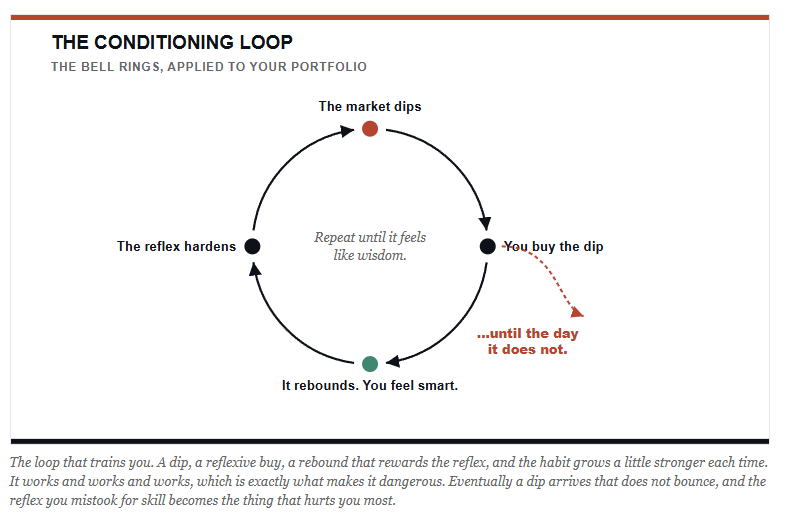
Here is the trap inside the training. The reflex feels like wisdom, because it keeps getting rewarded. Every time buying the dip works, you become more certain it always will, and a little more willing to take on risk to do it. That is not analysis. That is a salivating dog, and the cruel part is that the conditioning is strongest right when it is most dangerous, at the top of the cycle, after a long run of rewards, when everyone has been trained to believe the bell will ring forever. The reflex works right up until the dip that does not return, and that unfortunate outcome eventually comes.
The Awards You’ll Never Win
If you have gotten this far, congratulations. At this point, you should realize that your wiring and training, when combined, create a very specific catalog of self-sabotage. The market does not hand out trophies, but if it did, these are the ones people chase hardest without realizing the cost. Here are a few awards you will never actually want on your shelf.
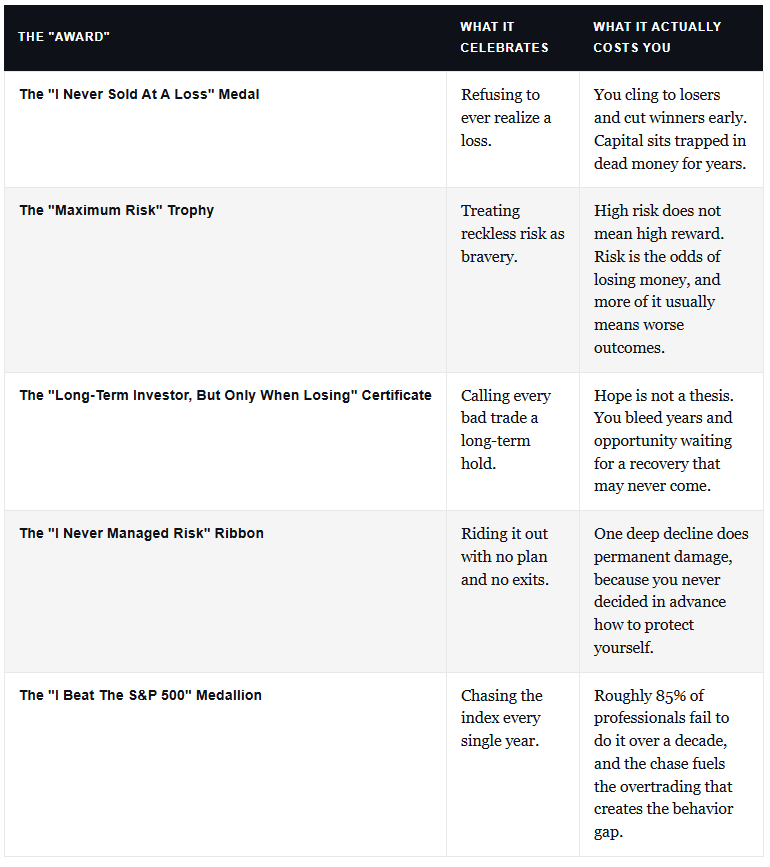
Examine those traits closely, and every one of these trophies is really the same mistake in a different costume. Loyalty to a position instead of loyalty to a process. The investor who cannot sell a loser is ruled by loss aversion. The one taking maximum risk has confused volatility with opportunity, when, as Jeremy Grantham puts it:
“You get rewarded for buying cheap, not for taking risk, and if you buy something only because it is risky, you get punished for it. “
The one who is a long-term investor only while underwater is rationalizing, not investing. Time spent nursing a broken position is time and money you never get back.
If you are still having difficulty tying this all together, a healthier way to picture it is to think about tending a garden. which is how I framed it before in our gardening guide to better returns. A good gardener does not fall in love with a dying plant. They weed what is failing, prune what has grown too large, and give room to what is healthy. A portfolio is no different. Selling a loser is not an admission of defeat. It is maintenance. And there is no ribbon for letting the weeds take over because you could not bear to pull one.
How To Beat Both Enemies
Here is the problem with investor psychology. You cannot rewire your instincts, and you cannot untrain years of conditioning by willpower. So you do the only thing that actually works. You build a process that does not care how you feel or what your reflexes are screaming. Here is where to start.
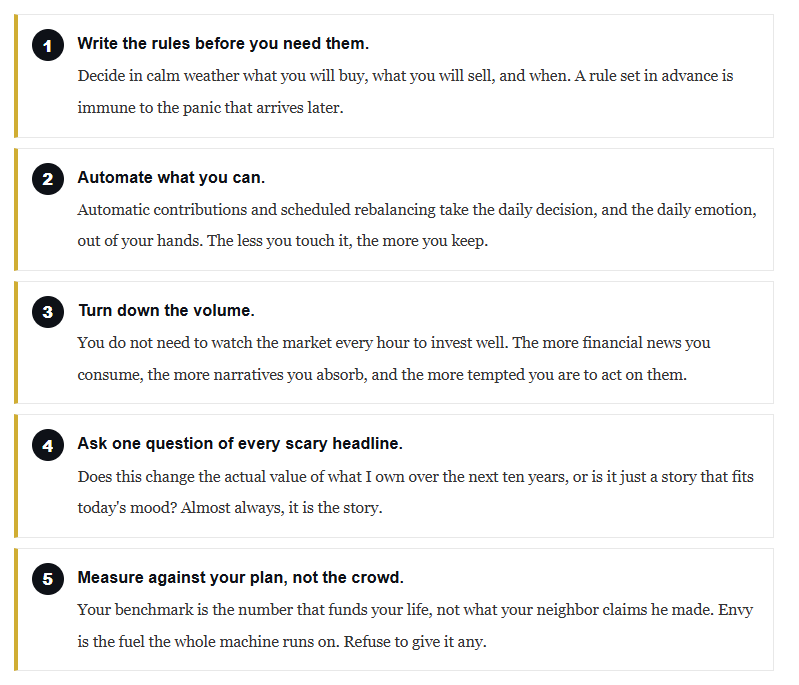
**Realize that the market does not take your money. You are giving it away, in small emotional installments. Those payments happen every time you buy a top out of greed or sell a bottom out of fear, usually with a headline egging you on. **The single most valuable skill in investing is not the analysis that you do. It has always been the discipline to sit still when every instinct and every screen is screaming at you to move.
However, discipline needs something to stand on. In the next installment, we will get to the hard numbers that make all of this concrete. Most notably, the brutal math of losses and why a 50% decline needs a 100% gain just to break even. Why the price you pay today all but sets your return for the next decade. And why, if you are anywhere near retirement, does the order in which those returns arrive matter even more than the average? It is the math Wall Street would rather you skip. We are not going to skip it.
If reading this raised a question about how your own money is actually positioned, whether you are truly investing or quietly speculating, that is the conversation worth having before the next bear market forces it on you. At RIA Advisors, our process starts with your complete financial picture, not just your brokerage balance. Schedule a complimentary consultation,*** and let’s talk about what the data means for you.*
Sources & Notes
- *Investor return gap: Morningstar, “Mind the Gap 2025” (data through Dec. 31, 2024). Average investor return 7.0% vs. 8.2% fund total return over the trailing decade. **morningstar.com*
- Bob Farrell, “10 Market Rules to Remember,” Merrill Lynch.
- Howard Marks, “The Most Important Thing,” and Oaktree memos on risk and cycles.
- Daniel Kahneman, “Thinking, Fast and Slow,” on loss aversion and prospect theory.
- Lance Roberts, “Narratives Change, Markets Don’t,” RIA Advisors.
- Treasury yield data: U.S. Federal Reserve via Massive Market Data. Ten-year yield 4.56% as of July 8, 2026.
